In Italy - the country to which we owe the magnificent art form of opera - music is still being composed that naturally carries on the tradition from Monteverdi through bel canto and verismo right into the 21st century. Without being lured down the dead-end path of atonality! You just have to set out in search of these gems. Perhaps the most significant contemporary composer is Marco Tutino.
Marco Tutino was born in Milan in 1954. Since the early 1990s, he has composed primarily for musical theater. His selection of literary sources and librettists has always been of the highest caliber (as with his most famous predecessors). At the same time, he has been active as a prominent music manager and opera artistic director in Italy. To this day, the opera houses he has directed - such as the Teatro Regio in Turin and the Teatro Comunale di Bologna - remain institutions of outstanding artistic merit and prestige. He is currently the artistic director of the Teatro Verdi in Pisa.
Marco Tutino. Source: www.marcotutino.it (SF Opera 2015)

I stumbled upon Marco Tutino by chance during the COVID-19 pandemic, when we had plenty of time to watch video streams. “La Ciociara” (which, for me, is Tutino’s most moving masterpiece) was being shown, and I was completely overwhelmed by an eruption of emotions, movement, and enthusiasm. That’s how I felt decades ago when I first heard the masterpieces of Verdi and Puccini and had to walk through the city at night for hours afterward because I was still completely electrified.
And Marco Tutino has so much in common with the great Italian masters, without copying them. He has his own original musical language, and he is a Verist - and I believe he stands by that. This is already evident in his very early opera „La Lupa“, composed for the Mascagni anniversary (1990) in Livorno, based on a story by Giovanni Verga (the author of the literary source for „Cavalleria rusticana“).
After the “La Ciociara” experience, I researched Marco Tutino and was completely stunned that I could have lived for decades without noticing this diverse body of work. Yet his works are no flash in the pan. His operas have been revived and performed multiple times by various theaters and festivals. Today’s “star” theaters and “super” stars apparently have never taken notice. Furthermore, from the film and photographic materials, I get the impression that Tutino is a modest person. He probably didn't think it was appropriate to include his own operas in the repertoire during his tenure as artistic director. I also didn't find any “stories” from his personal life.
The world premiere of the opera “Senso” (with a libretto by Giuseppe di Leva) took place in Palermo in 2011. One of the reasons for this was the 150th anniversary of the Unità d’Italia (Risorgimento).
The opera is based on a novella written by Camillo Boito in 1883. It tells the story of Countess Livia Serpieri’s passionate, obsessive love for the Austrian officer Lieutenant Hans Büchner, who, however, betrays and humiliates her. Taking advantage of her emotional dependence, he persuades her to leave him her fortune, which he uses to bribe Austrian military doctors so he can evade his military duties on health grounds. As the humiliations continue to escalate, Livia exposes his deception to the Austrian military. After his execution, Livia is left with feelings of both triumph and grief. Büchner’s cowardice and deceit are contrasted in the opera with the heroic figure of Marchese Roberto Donà.
Senso thus rests on two dramatic and musical pillars. On the one hand, passionate, human emotions (of veristic quality) and, on the other, historical-heroic aspects in the Verdi style (with scenes featuring variations on the Italian national anthem or Tosti’s folk song “Malìa”). While this music inevitably evokes the operatic titans of bygone eras, Marco Tutino’s brilliant musical originality transcends them.


Senso / Teatro Massimo di Palermo, mit Nicola Beller Carbone (Livia) und Brandon Jovanovich (Hans). © Studio Camera / Franco Lannino
There is a recording of the performance in Palermo on YouTube. A CD recording appears to be hopelessly out of print.
The world premiere of the chamber opera “The Servant” took place in Macerata in 2008. It is based on a short story by Robin Maugham (1948).
It is a highly erotic chamber drama about power and submission between master and servant in postwar England. A rather weak man (Tony, the master) is pitted against a toxic, destructive man (Barrett, the servant). The master’s weakness is reflected in the fact that, in accordance with social conventions, he cannot manage without a servant, is incapable of exercising respectful authority, and, again in accordance with social conventions, cannot cope with a superior woman (Sally). Both men compensate for their shortcomings by sexually oppressing the girl Vera.
Due to the English language, one subjectively senses a hint of Benjamin Britten, yet Tutino’s originality is unmistakable. This sophisticated piece, composed in a chamber music style, is available online in two versions.
The opera „Falscher Verrat“ is also essentially a chamber play, though set within a broader context: the 1918 Kiel Sailors’ Revolt - the event that preceded the end of the German Empire. The revolt was directed against the order to fight a final, hopeless battle against the superior British naval power.
Five characters become entangled in a web of deceit and betrayal. Rufus, the fleet commander, betrays the crew by attempting to send them into a completely hopeless battle, motivated solely by the honor of the German Empire. His daughter Elsa is married to Captain Arno, who intends to defy this order. Arno, for his part, is betrayed by the stoker Gabriel and accused of inciting mutiny - out of jealousy and resentment because Arno has become involved with the prostitute Lola, with whom Gabriel is in love. This is truly a complex web of wickedness and false values, and only the prostitute Lola appears to rise above it all, embodying true human morality.
A few years later, this opera premiered in Italian in Sassari, Italy.


Kiel 2018, Falscher Verrat (links), mit Agnieszka Hauzer (Lola), M. Müller Kasztelen (Gabriel) und T. Takada (Arno). © Theater Kiel / Olaf Struck
Sassari 2024, Falso tradimento (rechts), mit Valentina Mastrangelo (Lola), Dario di Vetri (Gabriel), Giorgio Caoduro (Arno). © Elisa Casula


The Summit of Tutino’s Compositions:
La Ciociara / Teatro Lirico di Cagliari (links), mit Anna Caterina Antonacci (Cesira), Lavinia Bini (Rosetta), Aquiles Machado (Michele). © Priamo Tolu / Teatro Lirico di Cagliari
La Ciociara / Wexford Opera Festival (rechts), mit Na’ama Goldman (Cesira), Jade Phénix (Rosetta), Devid Cecconi (Giovanni). © Clive Barda
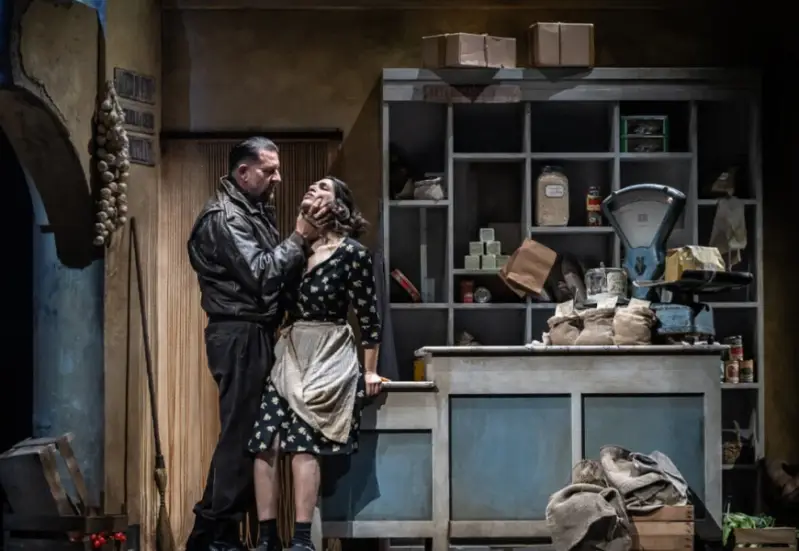

In „La Ciociara“ in particular, Marco Tutino shows how music can touch people’s emotions. What moves us - love, hate, war, power, the cruelty of war, and the suffering it causes, especially to women … to women who are ultimately more emotionally rich than men and who struggle to maintain their humanity under inhuman circumstances. All of this moves people through music as we have experienced it for hundreds of years, and not through “music” based on mathematical gimmicks. This evokes compassion and catharsis and thus ultimately fulfills one of the purposes of theater.
The opera “Vita” introduces us to an entirely new theme. Victoria Bearing (known as Vita since childhood), a terminally ill scholar, puts herself at the mercy of a self-satisfied and ignorant community of medical professionals who refuse to acknowledge their own inadequacy in the face of illness and death, all in the hope of staying alive. They hope that a daring therapeutic experiment will earn them recognition in their scientific community, and Vita initially agrees to it. Vita draws strength from what has defined her life and career - the arts, especially the poetry of John Donne (England, 16th/17th century), who, in her imagination, stands by her on stage as she endures her ordeal. Ultimately, however, she overcomes her suffering with the strength she draws from her world of John Donne. Another moving work, premiered in Milan (2003), a stream of which is available from Szeged.
Marco Tutino’s (so far) only comic opera, „Miseria e Nobiltà“, premiered in Genoa in 2018. However, this designation should by no means be understood as a farce in the style of Rossini. True to its title, it features socially critical themes and elegiac love scenes, presented with a lighthearted wink and a happy ending. And in keeping with the tradition of lighthearted Italian operas, it has a complicated plot, which I’d like to outline here (from Wikipedia):
Act I
Naples, June 1946, during the days of the referendum on the monarchy versus the republic. Felice, a former teacher who lost his job after refusing to join the Fascio, lives with his son Peppiniello in a ground-floor apartment and tries to make ends meet as a scribe. He receives a visit from Gemma, the prima ballerina of the Teatro di San Carlo, and her fiancé Eugenio, the son of Prince Ottavio di Casador (a former student of Felice’s).
The two lovers ask him for help. Don Gaetano, Gemma’s father, has invited Eugenio’s father to dinner. But Eugenio’s father - though secretly in love with Gemma himself - refuses to allow his son to marry a dancer. The desperate couple begs Felice to help them by pretending to be the Prince of Casador and agreeing to meet Don Gaetano for dinner.
After initially refusing outright, Felice is persuaded by a sumptuous spaghetti meal that Gemma has delivered to his home for all the residents of the ground floor.
Meanwhile, Peppiniello - who has been sent by his father to pawn a coat - runs into Bettina, Don Gaetano’s maid, on the street. Bettina is his mother, but Peppiniello cannot remember her and is convinced that his mother emigrated to America.
Act II
After a quarrel with his father, Peppiniello has found a job as a kitchen boy, thanks to Bettina. Felice, in the role of Ottavio, arrives for dinner and meets Don Gaetano, trying his best to embody the Prince of Casador. A chance encounter with Bettina threatens to ruin the charade.
The two, once husband and wife, separated after Bettina had an affair—with the Prince of Casador, of all people. For this reason, Felice won’t let her see her son.
Thanks to Gemma and Eugenio’s pleas, the play continues, but is immediately interrupted by the arrival of the real Prince Ottavio di Casador, who has uncovered his son’s plans. Gaetano, who is initially confused, doesn’t understand which of the two is the real prince.
The mystery is easily solved when the radio announces the Republic’s victory in the referendum and Felice can’t help but cheer.
Faced with the prince’s arrogance—he admits to having taken advantage of Bettina by lying about promising her a job for Felice, and views Bettina and Gemma as women with whom one can have casual fun—Don Gaetano explodes. Since he no longer cares about Ottavio’s approval, he blesses Eugenio’s marriage to his daughter Gemma.
Felice forgives Bettina. The two are reunited with their son Peppiniello, while the people celebrate the birth of the Italian Republic in the streets of Naples.


Miseria e Nobiltà, Genova 2018, mit Alessandro Luongo (Felice), Valentina Mastrangelo (Bettina), Fabrizio Paesano (Eugenio), Martina Belli (from danzaeffebi.com – Francesca Bernabini / Marcello Orselli – fotografo di scena)

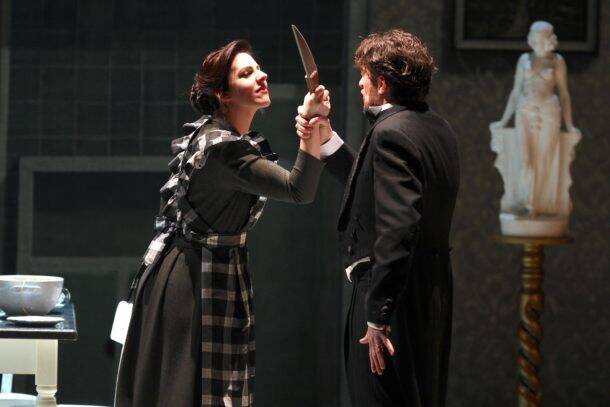
“La Lupa” is based on a typical Sicilian story by Giovanni Verga with a tragic ending. La Lupa is an unconventional village beauty who passionately desires and seduces the very man she has married to her daughter. I found a 1998 streaming version of it.
The opera “Le Braci” is probably still available on CD (Dynamic label), for example through the JPC online store:
https://www.jpc.de/jpcng/classic/detail/-/art/le-braci/hnum/2897247
What I’m presenting here is just a very small part of Marco Tutino’s operatic oeuvre. I would love to use my blog to open a door to this fantastic world for other opera lovers.
People / Composers like Marco Tutino introduced me to opera. I would have had to spend my life without opera if I had taken my first steps into an opera by Berg or Cerha. If we want to get more people excited about opera, we need to introduce them to composers like Tutino. Enjoying his music isn’t old-fashioned or backward. He captures the emotions that move people in music and, through its beauty, makes us more sensitive human beings.
Mille grazie, caro Maestro!
In any case, I’d like to visit the Teatro Verdi di Pisa - the great composer’s current workplace - as soon as possible.
Teatro Verdi di Pisa (Photo aus terredipisa.it)


Marco Tutino’s Singers
Anna Caterina Antonacci (©Maria-Noëlle Robert; portraying Vita and Cesira)
Laura Cherici (Photo from bach-cantatas.com; portraying characters in „Vite immaginarie“, „La Lupa“)
Valentina Mastrangelo (Photo from teatrodipisa.it; portraying Bettina, Lola)
Roberto Scandiuzzi (Photo from alchetron.com; portraying Henrik, von Bock)
Alfonso Antoniozzi (Photo from emiliaromagnanews24; portraying Barrett, Konrad, Don Gaetano)
Giuseppina Piunti (©Patrizia M. Burr; portraying Sally)


Links to operas by Marco Tutino, some of which can also be found on his website. Unfortunately, the videos on YouTube are very often interrupted by annoying ads, so you often have to look for alternative options.
La Ciociara (Cagliari 2017) with Giuseppe Finzi (conductor), Anna Caterina Antonacci (Cesira), Lavinia Bini (Rosetta), Aquiles Machado (Michele), Sebastian Catana (Giovanni), Roberto Scandiuzzi (Fedor von Bock).
https://www.youtube.com/watch?v=MftEy2Af96I
La Ciociara (Wexford 2023) with Francesco Cilluffo (conductor), Na’ama Goldman (Cesira), Jade Phoenix (Rosetta), Leonardo Caimi (Michele), Devid Cecconi (Giovanni), Alexander Kiechle (Fedor von Bock).
https://www.youtube.com/watch?v=6repDORJvYk
Senso (Palermo 2011) with Pinchas Steinberg (conductor), Nicola Beller Carbone, Brandon Jovanovich, Dalibor Jenis.
https://www.youtube.com/watch?v=LKqulNghsm0
The Servant (Macerata 2008) with Guillaume Tourniaire (conductor), Alfonso Antoniozzi (Barrett), Mark Milhofer (Tony), Giuseppina Piunti (Sally), Ruth Rosique (Vera).
https://www.youtube.com/watch?v=439x8WBPKhU
The Servant (Lugo 2011) with Francesco Cilluffo (conductor), Alexej Bogdanchikov (Barrett), Peter Furlong (Tony), Giuseppina Piunti (Sally), Camille Dereux (Vera).
https://www.youtube.com/watch?v=IHiQgR4Y5uo
Miseria e Nobiltà (Genova 2018) with Francesco Cilluffo (conductor), Alessandro Luongo (Felice), Martina Belli (Gemma), Fabrizio Paesano (Eugenio), Alfonso Antoniozzi (Don Gaetano), Andrea Concetti (Ottavio di Casador), Francesca Sartorato (Peppiniello), Valentina Mastrangelo (Bettina).
https://www.youtube.com/watch?v=VT1AGO7LNRw
Vita (Szeged 2009) with Olivier von Dohnanyi (conductor), Zuzana Dunajcanová (Vita), Zuzana Marková (Susan), Marc Haffner (Posner), Chad Armstrong (John Donne).
https://www.youtube.com/watch?v=1tS24abURhI
Falscher Verrat (Kiel 2018) with Lars Peter (conductor), Michael Müller-Kasztelen (Gabriel), Tomohiro Takada (Arno), Agnieszka Hauzer (Lola), Tatia Jibladze (Elsa), Jörg Sabrowski (Rufus).
https://www.youtube.com/watch?v=2MEs4D85KTM
Falso Tradimento (Sassari 2024) with Beatrice Venezi (conductor), Valentina Mastrangelo (Lola), Dario di Vetri (Gabriel), Giorgio Caoduro (Arno), Anna Pennisi (Elsa), Tiziano Rosati (Rufus).
https://www.youtube.com/watch?v=K5j-J333fH0
La Lupa (Palermo 1998) with Donato Renzetti (conductor), Adele Gossi (La Lupa), Manrico Tedeschi (Nanni), Donatella Lombardi (Mara), Alberto Mastromarino (Maresciallo), Iorio Zennaro (Nicola).